

Transforming thought into action
Leaders and organisations need better frameworks for making sense of complexity – for sorting fact from fiction, priority from urgency, and insight from noise.
Most leadership programmes teach what to think. We focus on how to think and why it matters.
At Triliteral, we develop practical frameworks for decision-making, collaboration, and culture. Our integrated approach turns abstract insight into everyday practice, helping leaders and teams think more clearly, act more decisively, and align more effectively.
This isn’t theory for theory’s sake. It’s thinking designed for action, built to create meaningful, measurable change.
The Triliteral process:
Structured learning for lasting change
We design our programs to develop cognitive mastery over time, using a spiral learning process that builds awareness, skill, and competence.
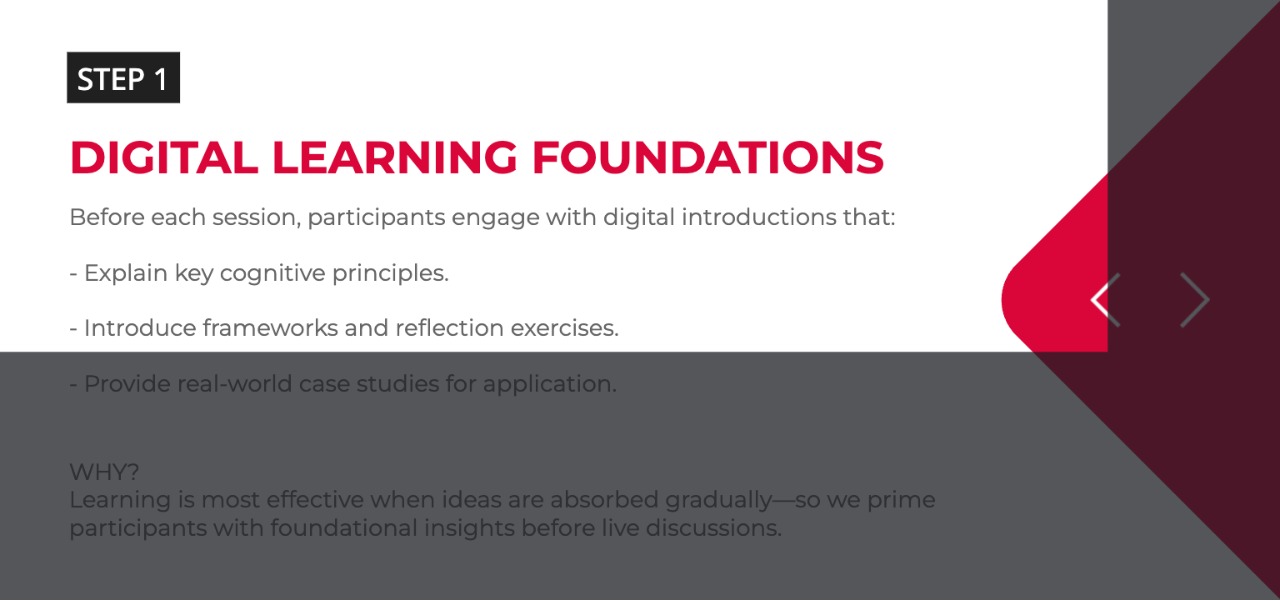
DIGITAL LEARNING AS THE GROUNDWORK
STEP 1
Concepts and tools act as the foundation of cognitive mastery.
These online, asynchronous integrated sessions:
- Outline and explain key learning concepts.
- Use exercises and reflections to unpack new frameworks.
- Explore business and personal case studies for real-world learning.
WHY?
Learning is most effective when ideas are absorbed gradually, so we prime participants with introductory knowledge to facilitate higher order learning.

LIVE INTERACTIVE SESSIONS
STEP 2
Then, we dive into collaborative workshops (online or in-person) that build the introductory theory into a set of skills. In these, we will foster competence through:
- Socratic discussions exploring new mental models and perspectives.
- Peer-to-peer learning and discussion, using exercises to interrogate and test knowledge.
- Reflection points, allowing participants to consolidate learning in real-time.
WHY?
Cognitive mastery develops through interaction, challenge, and iteration, not passive learning.

REFLECTION FOR INTEGRATION
STEP 3
We often learn something new, only to forget it later. We systematise
and embed learning through repeated application and introspection:
- Self-reflection exercises which extend learning.
- Cognitive restructuring worksheets for integrating into daily life.
- Testing learning and assumptions through novel problems.
WHY?
Cognitive mastery is a skill that requires constant practice, so we
ensure learning continues after the session ends.